Experimental history • Case Study 001
How Wayli went from 84 to 100
This dated record covers the retired AIR scoring experiment. It is not a current assessment, score or service.
Final recorded experimental result100 / 100AIR v3
Historical assessments: 84 → 88 → 96 → 100
How Wayli's recorded score reached 100
Wayli has been an AIR test subject from the start. We've used its findings to improve Wayli, and Wayli has helped expose where AIR itself needed improving.
The final experimental assessment recorded 100/100 under AIR V3. This reflects both that journey and a methodology change: V3 asks whether AIR can establish an intended audience, with confidence reported separately.
The previous 92/100 under V2 remains valid under the methodology that produced it.
The chronology below separates changes made to Wayli's public information from later changes to the experimental methodology.
Here's the journey
- Business
- Wayli
- Industry
- Decision support platform
- Original assessment period
- 10 July – 29 July 2026
- Original assessments
- 4
- Original score path
- 84 → 100 (+16 points)
- 84
- 88
- 96
- 100
The research method
- Assessment
- Finding
- Research
- Implementation
- Reassessment
- Learning
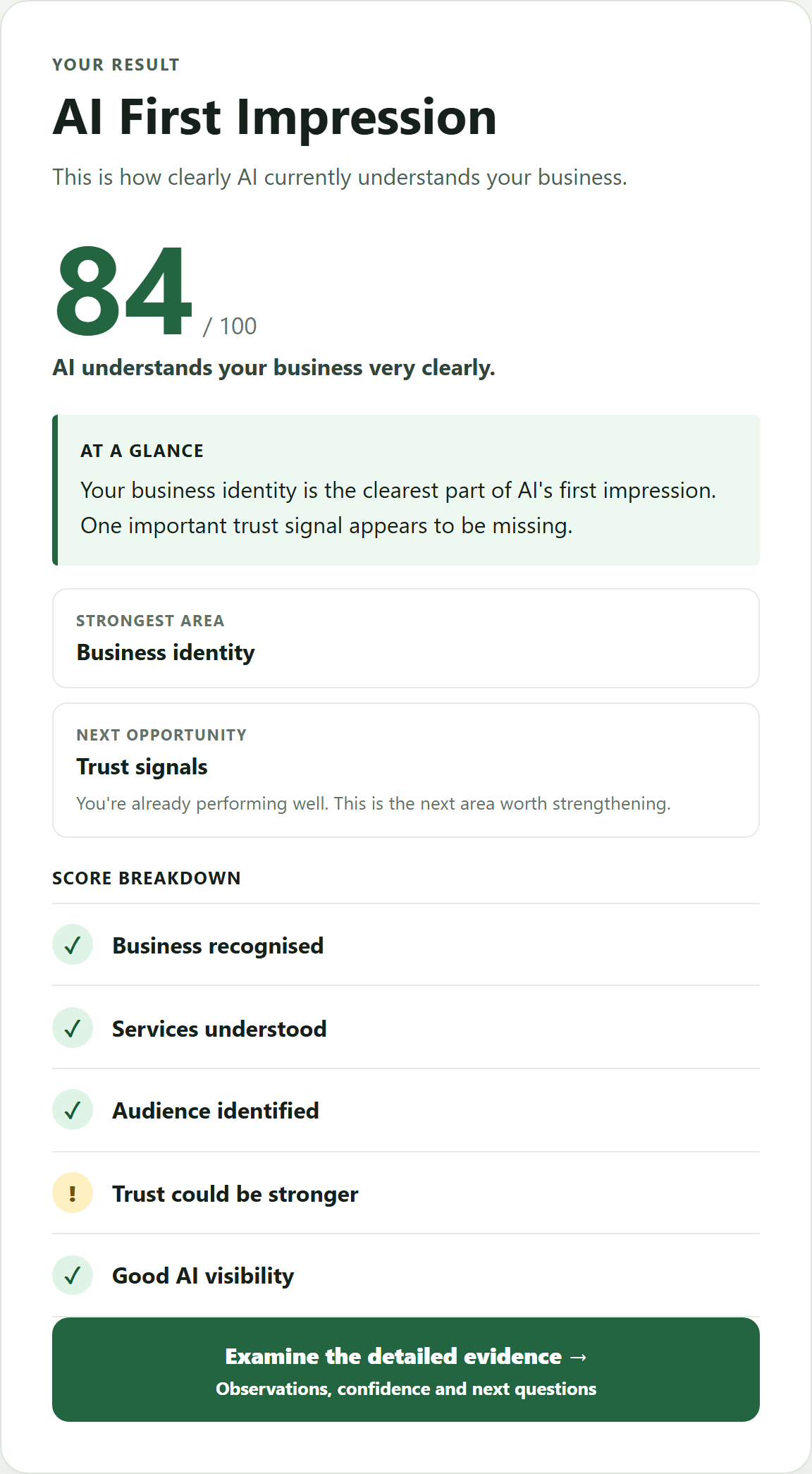
Assessment One
10 July 2026
84 / 100
Finding
Wayli's identity, services and audience were recognised, but the assessment found an important gap in the public evidence supporting trust and authority.
Research undertaken
Rather than making assumptions, we investigated the finding before changing the website or assessment.
Changes implemented
- Expanded the founder story so the people and experience behind Wayli were easier to establish.
- Launched Wayli Labs and began documenting the research behind the product in public.
- Reworked the description of Wayli and strengthened the public evidence explaining what it is and why it exists.
Result
The next assessment recognised the stronger trust evidence while retaining its clear understanding of the business, services and audience.
84 → 88
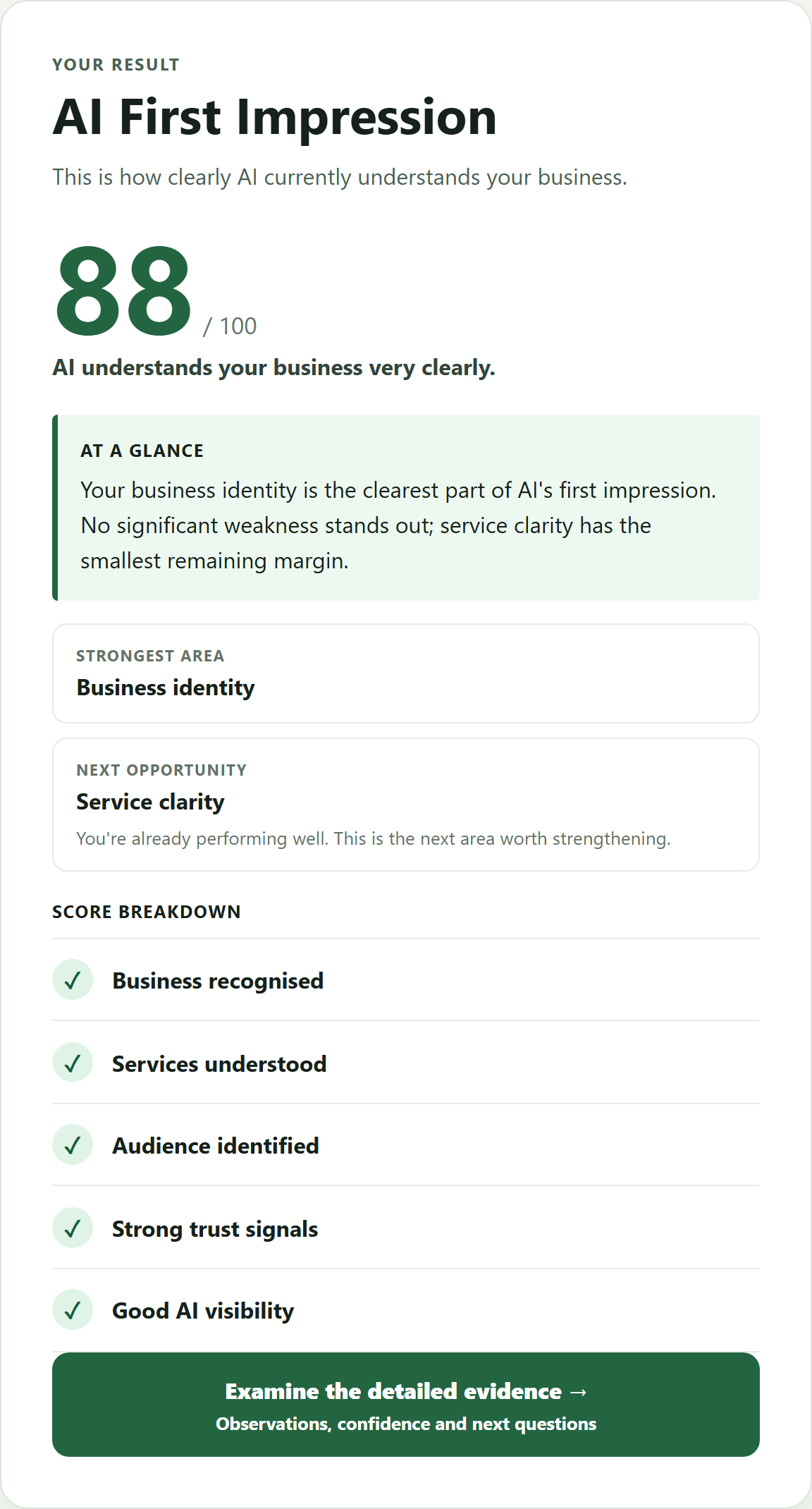
Assessment Two
15 July 2026
88 / 100
Finding
The original trust gap had been resolved. The remaining work was about reducing uncertainty: making Wayli's purpose, product relationships and public research easier to understand.
Research undertaken
Rather than making assumptions, we investigated the finding before changing the website or assessment.
Changes implemented
- Clarified who Wayli is for and what Wayli does.
- Strengthened the relationships between Wayli's products and made their language more consistent.
- Published more research, improved public authority signals and added an llms.txt file to make the business easier for AI systems to identify.
Result
The following assessment found stronger, more consistent evidence across the site. The report moved from identifying a weakness to isolating one final marginal opportunity.
88 → 96
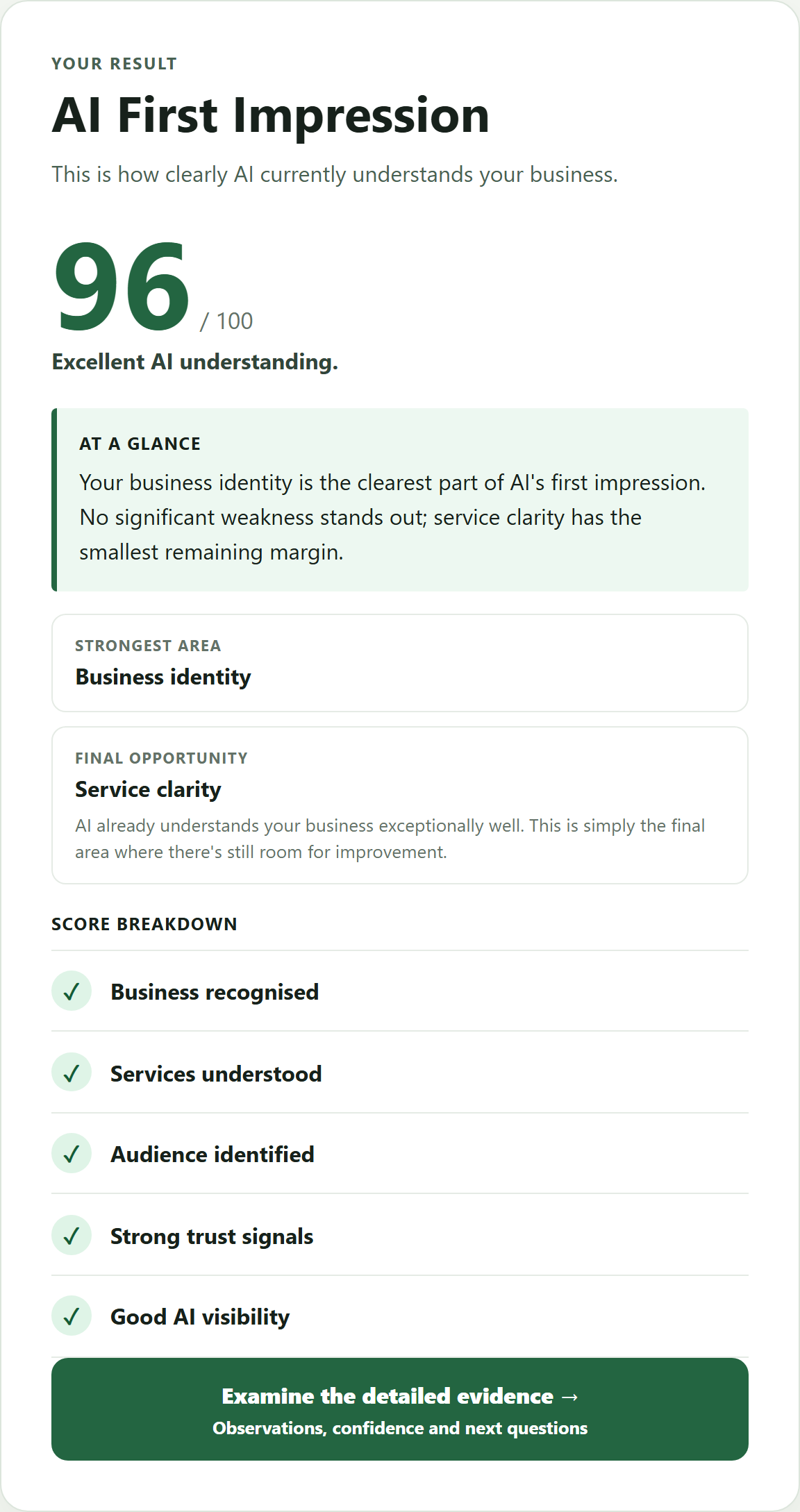
Assessment Three
21 July 2026
96 / 100
Finding
Wayli's public evidence was consistently strong. A methodology audit then revealed that the Offer assessment could only return 80 of its intended 100 points, making a 100-point overall result mathematically unreachable.
Research undertaken
The implementation audit that followed this assessment is linked with the resulting 100-point checkpoint below.
Changes implemented
- Traced the Offer evidence through the deterministic assessment pipeline.
- Corrected the implementation so all five evidence signals already defined by the methodology could be returned to the scoring logic.
- Reran 99 historical assessments and 29 live benchmark websites to check that no other assessment area moved.
Result
The corrected implementation recognised the evidence that had previously been omitted. This final four-point change was an assessment correction, not a further change to Wayli's website.
96 → 100
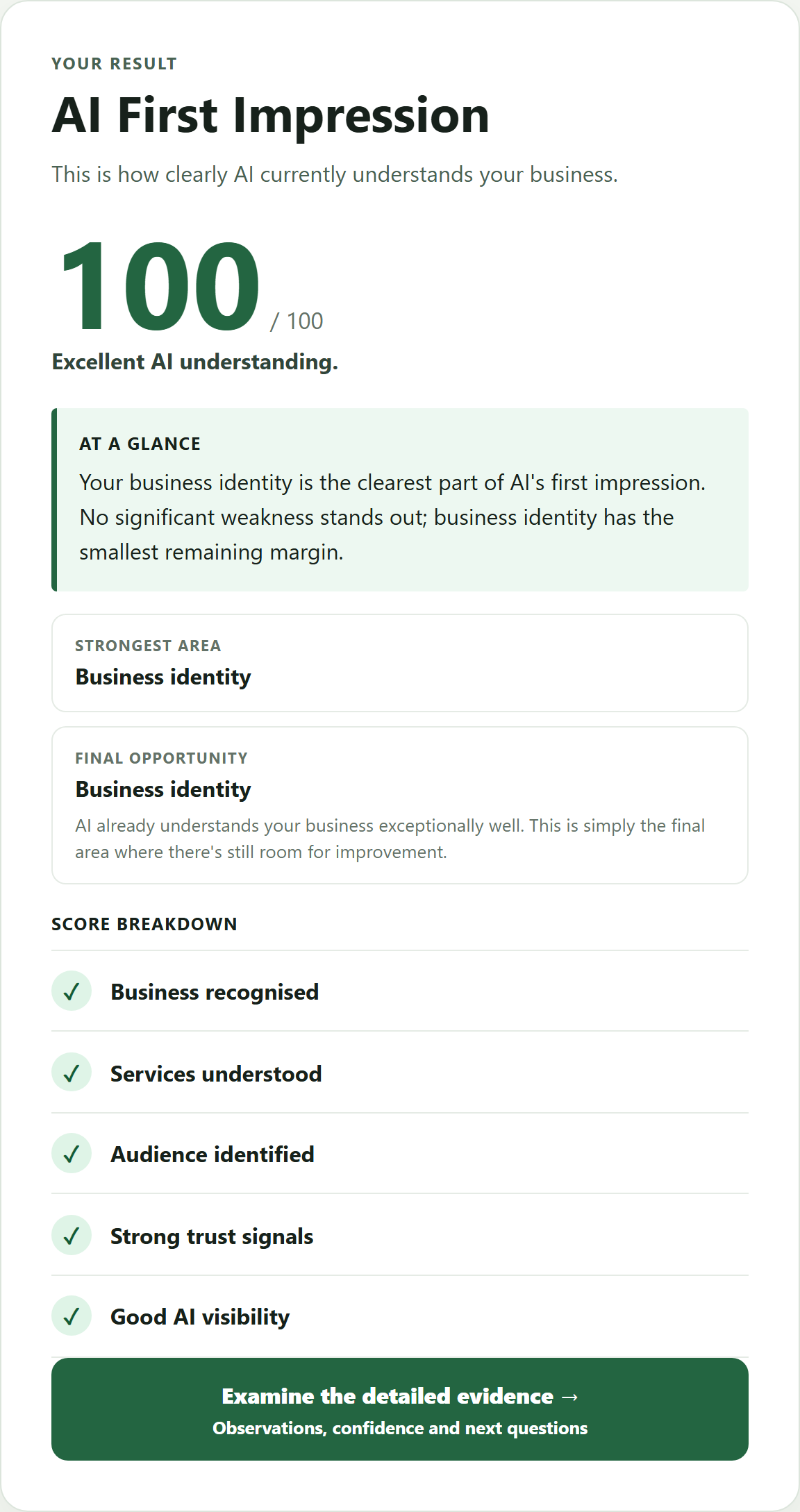
Assessment Four
29 July 2026
100 / 100
Finding
The assessment recognised Wayli clearly across every published category. No structural weakness remained within the assessment framework.
Research undertaken
Rather than making assumptions, we investigated the finding before changing the website or assessment.
Changes implemented
No later implementation is claimed within this case study.
Result
This assessment closes the original 84 → 88 → 96 → 100 methodology era. Later assessments are recorded separately because AIR's evidence and acquisition methodology subsequently changed.
A later methodology era
Where the assessment went next
AIR's evidence methodology was later strengthened so that every score-bearing conclusion had to be traceable to evidence it could deterministically defend.
Under AIR v1, a fresh Wayli assessment scored 80. Testing that result exposed an acquisition problem: AIR had discovered relevant product and question pages, but its bounded assessment was not selecting a representative enough sample of the website.
Historical methodology checkpoint
AIR v1
80 / 100
- Who You Are
- 100
- What You Offer
- 100
- Who You Help
- 0
- Why You're Trusted
- 100
- Information Access
- 100
Historical methodology checkpoint
AIR v2
92 / 100
- Who You Are
- 100
- What You Offer
- 100
- Who You Help
- 60
- Why You're Trusted
- 100
- Information Access
- 100
This is not simply a story about Wayli improving from 80 to 92. The two results belong to different methodology eras. Wayli's content evolved during the investigation, but AIR v1 did not inspect many of the pages where that evidence lived.
AIR v2 changed where AIR looked without loosening what its evidence rules could conclude. It now examines the homepage and up to five representative supporting pages.
Under AIR v2, Audience was partially established at 60 with Medium confidence. That historical 92-point result remains valid under the methodology that produced it.
AIR v3 asks a narrower Audience question: can AIR establish an intended audience from the public evidence it acquired? A passing Audience result scores 100, while confidence remains separate.
This methodology change moved Wayli from 92 under V2 to 100 under V3. It is not presented as a website improvement or a retrospective correction to the V2 result.
Latest assessment
AIR v3
100 / 100
- Who You Are
- 100
- What You Offer
- 100
- Who You Help
- 100
- Why You're Trusted
- 100
- Information Access
- 100